Read Time:6 Minute, 21 Second
In a rather belated post, I’d like to share a few stories about my time in Uzbekistan.
My visa for Uzbekistan finally in hand, I hopped on an overnight bus from Bishkek, Kyrgyzstan across the border to Shymkent, Kazakhstan. Because it had taken me so long to get this visa, it would have to be a quick trip. I only spent a few hours in Tashkent, the capital, after crossing the border. I was there just long enough to visit Chrosu Bazaar, the city’s largest market, change money, and catch my onward train in Samarkand. I did snap a few photos though.
 |
| The dome of Chorsu Bazaar, the largest market in Tashkent. The meat and dried fruit sellers congregate in this area. |
 |
| A deserted children’s playground in the heart of Tashkent |
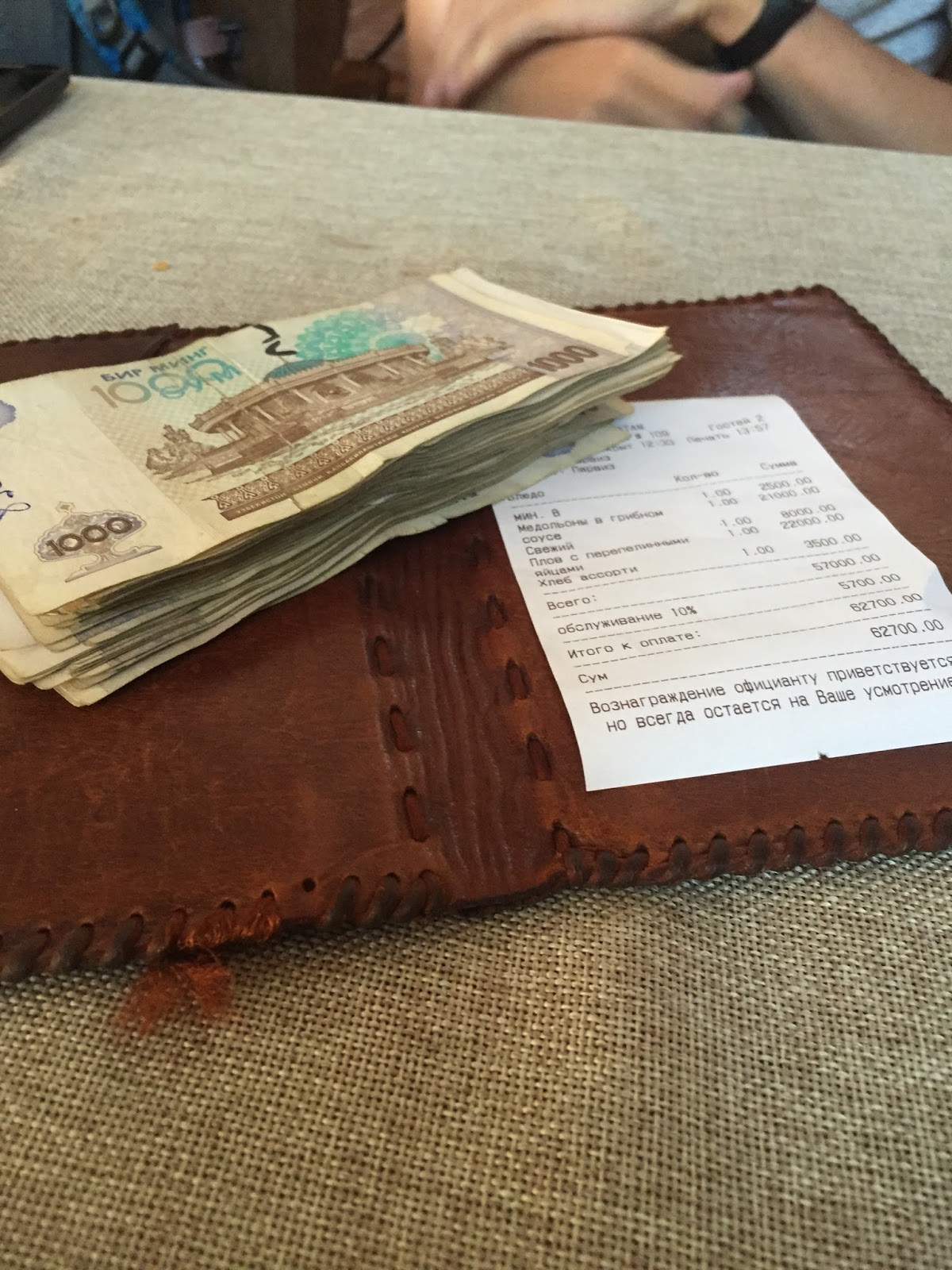
At the bazaar in Tashkent, I also changed some of my US Dollars to Uzbek Soms. There are two exchange rates for the som: the official rate set by the government and the black market rate. During my visit, one dollar was worth around 3,200 soms at the official rate, but on the black market you could get between 6,100 and 6,500 soms. On top of this, the largest note in Uzbekistan is 5,000 soms, and these are quite rare compared to the 1,000 som notes. Changing $100 into soms means you’ll be given several fistfulls of cash, enough to fill a small backpack. It’s particularly bad if your money changer refuses to give you 5,000 som notes, which are at a premium.
 |
| Roughly $100 in Uzbek Soms. The 100 som notes at the front left were worth less than 2 US cents when the photo was taken. |
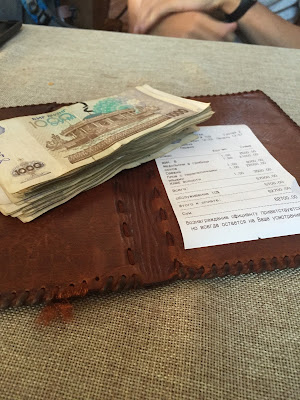 |
| An Uzbek dinner bill for two with a fat stack of cash to pay it. At the black market rate, it was less than $5 per person. |
After that short stop in Tashkent, I was on a train to Samarkand, formerly the center of a vast medieval Islamic empire that stretched from Iraq to India at its zenith. It emerged primarily due to the military genius of Timur (1336-1405), known in the West as Tamerlame (Timur the Lame) because of injuries he received in battle. He and his descendants built fantastic mosques and madrassahs (religious schools) in Samarkand, decorated with elaborate blue and turquoise tilework. Most of my time in Uzbekistan would be spent visiting such sites.
My hotel was located very close to the mausoleum of Timur himself, Gur-e-Amir (“Tomb of the King”). The architectural features of this tomb are quite typical of what I was to see all over Uzbekistan – soaring domes, towering minarets, and elaborately tiled portals.
 |
| Gur-e-Amir, the tomb of Timur |
 |
| The ceiling of Gur-e-Amir, taken at night when I sneaked in for a few more photos |
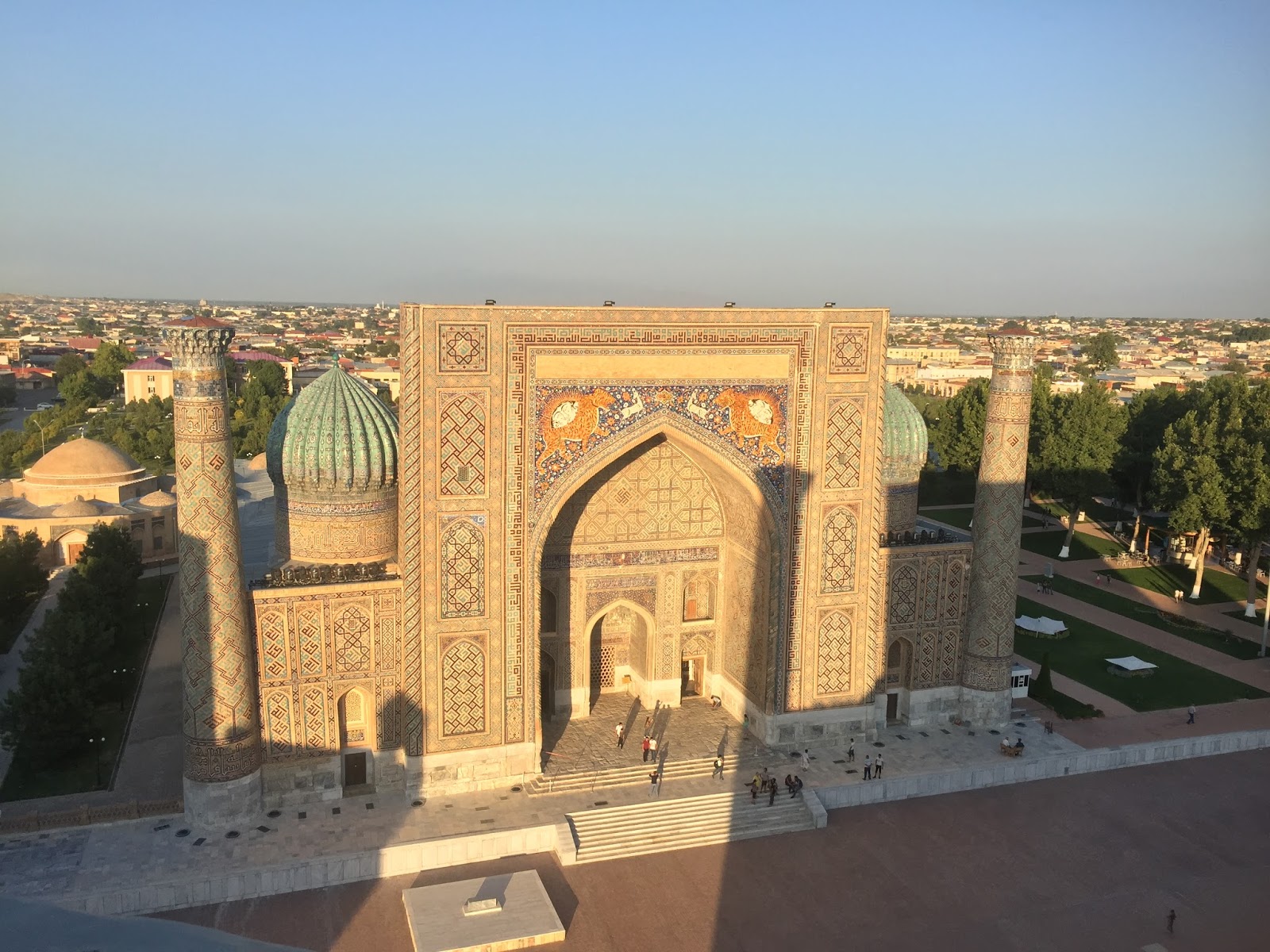
Samarkand’s signature attraction is the Registon, a square surrounded by three madrassahs: Ulug Beg ( completed re. I returned to this location twice to take photos during both daylight and sunset. The buildings were spectacular. Though it is Samarkand’s signature attraction, I didn’t find it to be too overcrowded with tourists. Perhaps it was because of the warm weather during this summer season.
 |
| The entrance of the Sher-Dor Madrassa. The animals above the arch contravene Islamic prohibitions on the portrayal of living things. |
 |
| The elaborately tiled and painted ceiling of the Sher-Dor Madrassa |
 |
| The entrance to the mosque that is a part of the Tilya-Kori Madrassa, with its brilliant turquoise dome |
 |
| Detail of tilework in the Registon |
For a small “fee”, you can pay to climb one of the twin minarets of Ulug Beg Madrassa and see the view of Samarkand from the top. It is one of the tallest buildings in the area, and the view from the top is impressive.
 |
| The winding staircase inside the minaret (tower) of the Ulug Beg Madrassa, which I climbed |
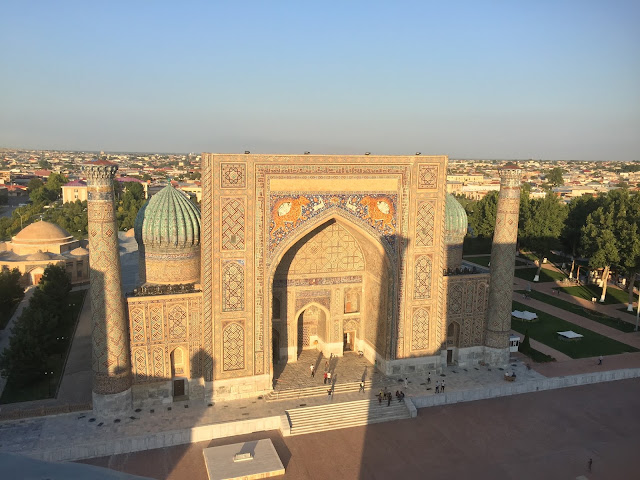 |
| The view from the top of the minaret, looking towards the Sher-Dor Madrassa |
I returned to the Registon later in the evening to take further photos as the sun was setting. There were only a few minutes between when the buildings were illuminated and when I was kicked out of the complex by the guards.
 |
| Tilya-Kori Madrassa at sunset |
 |
| One of the towers of Tilya-Kora Madrassa |
After my visit to the Registon, I went to the Bibi Khanem Mosque, originally completed in 1404. The exterior had been beautifully restored, including the massive portal, but the interior remained in its ruined state.
 |
| The courtyard of the mosque, showing one of the side domes and the rear of the main entrance |
 |
| The interior of Bibi Khanem Mosque reflects the building’s six centuries of exposure to earthquakes and weather |
One of my favorite activities in Samarkand was a visit to a carpet factory, where the owner’s helpful wife showed me around and explained the carpet-making process. Typically carpet-making is considered women’s work, and it serves as one of the few socially-acceptable ways for women to earn money in Central Asia. At this factory, they offered both silk and wool carpets for sale. The silk carpets are made right here in the building, while the wool carpets are imported from Afghanistan.
My host at the factory was particularly interesting. She and her husband were both Afghani: she was born in Badghis while her husband was from Mazar-i-Sharif. They left Afghanistan in 1992, the year Mohammad Najibullah’s pro-Soviet government collapsed and the second phase of the Afghan Civil War began, ultimately bringing the Taliban to power in most of the country. They initially tried to set up their business in Bukhara, the city most famous for its carpet merchants, but moved it to Samarkand.
The carpet-making process is very labor-intensive. First the warp threads (typically cotton) are wrapped around the loom in a continuous loop. Then the women go to work tying the thousands of knots that make up the pile of the carpet. Each knot is tied with blinding speed using a special tool that combines a knife and a hook to pull the yarn through the knot. There are typically at 80-300 knots per square inch of carpet. Even a medium-sized rug might have a hundred thousand knots.
 |
| Three women at work on a particularly large carpet |
After saying a happy goodbye to the women at the carpet factory, I visited one of the last remaining Jewish synagogues in Samarkand. The community here, a distinct sect called Bukharan Jews, has dramatically decreased in recent years. Large numbers have emigrated to Israel, and today there are only about a hundred remaining. Their beautiful house of worship was one of the last things I expected to find in a sleepy backstreet in Samarkand.
 |
| The interior of the synagogue in Samarkand |
 |
| A very old copy of the Talmud – note the Russian lettering along the bottom |
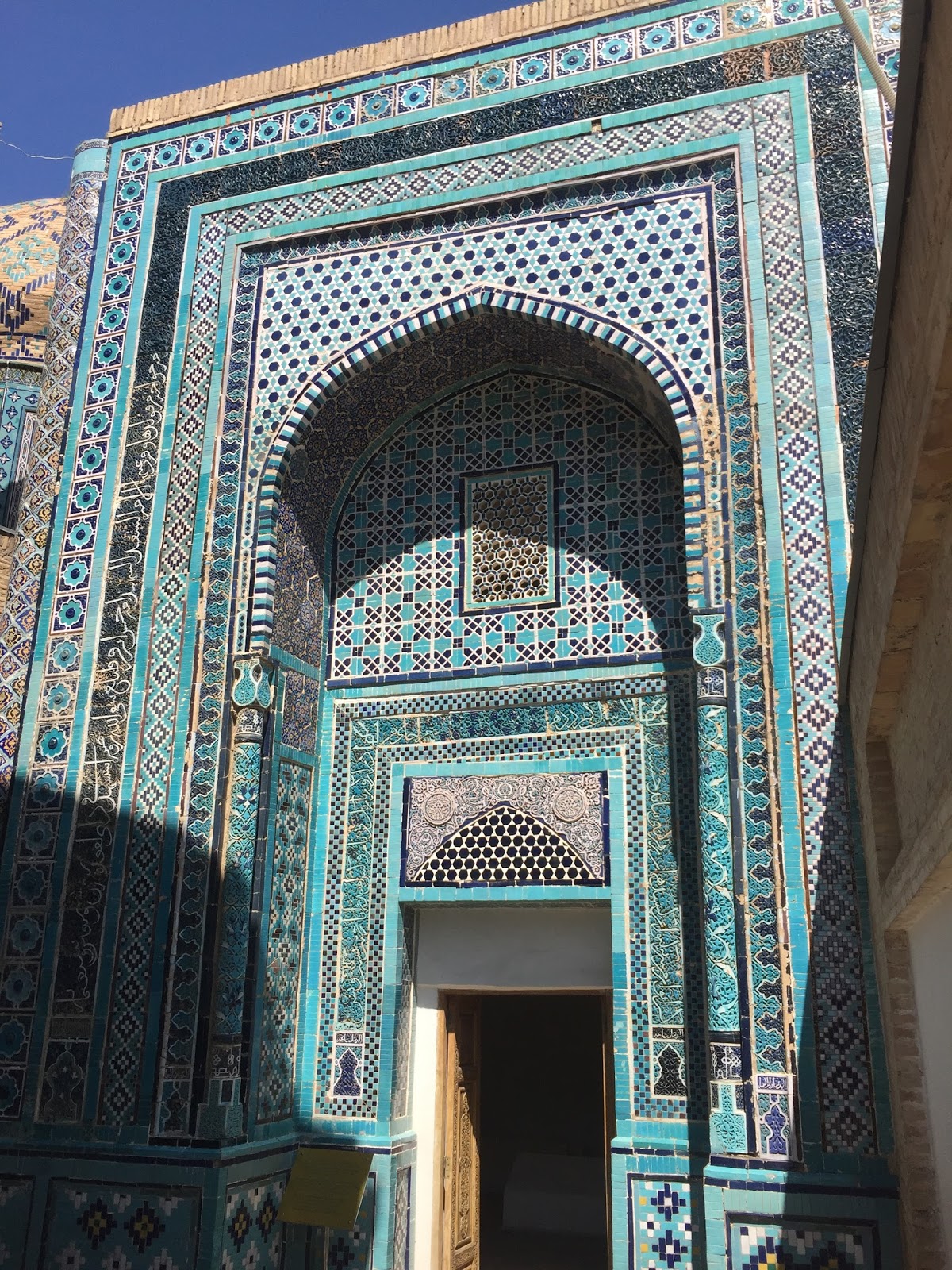
My final stop in Samarkand was the Shah-i-Zinda Ensemble, a complex of tombs that began construction during the 11th Century. Burials continued into the 19th Century. The carved and glazed porcelain tiles were especially beautiful here, and restoration work was still underway in some places.
 |
| A particularly detailed tile mosaic, painted by hand. |
 |
| Detail of the carved porcelain tiles at the Shar-i-Zinda Ensemble |
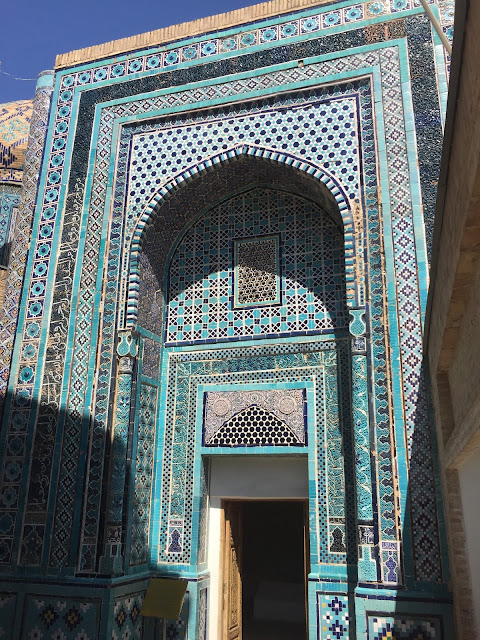 |
| Entrance to one of the mausoleums |
 |
| The entrance to another mausoleum |
 |
| An elaborate squinch connects the octagonal dome above to the square room below |
 |
| Restoration work underway at the Shah-e-Zinda ensemble |
From Samarkand I went to Bukhara, another ancient caravan city and home to several empires that dominated this region at different times. I traveled by shared taxi for this journey, which I’ll detail in my next post.

Happy
0
0 %

Sad
0
0 %

Excited
0
0 %

Sleepy
0
0 %

Angry
0
0 %

Surprise
0
0 %
 0
0
 0
0









Fabulous adventure. You will be à Great writer, believe me. Just continue to make us dream