Just over the Mauritanian border from Western Sahara is the country’s largest city, Nouadhibou. This town is a critical seaport where iron ore from the country’s north is brought to the coast and shipped to world markets. For the most part, it’s an uninspiring town.
Nouadhibou used to be known among adventure travelers for its ship graveyard, where old hulks were dumped to rust away. Most of this has been cleaned up in recent years, and only a few ghostly ships remain off the coast.
Alcohol is illegal in Mauritania, but if you know where to look and are willing to pay six dollars for a can of terrible beer, you can find it in certain restaurants that cater to foreigners. Even where alcohol is illegal, there’s always someone looking to party.
I walked down to the nearby town of Cansado, a company town built for the employees of SNIM, the state-owned iron mining company. Residents live in SNIM housing, shop at the SNIM store, and pray in the SNIM mosque. I snapped a few photos nearby before heading back to the hotel.
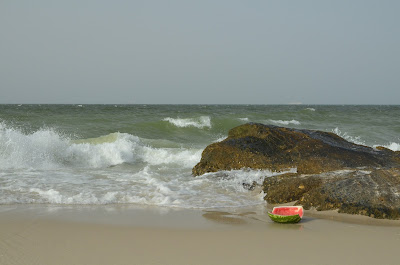 |
| Waves lap at a hollowed-out watermelon near Cansado |
After visiting Cansado, I caught the next train out of town. The only train in Mauritania is owned by SNIM, and it carries iron ore from the mines in the country’s north to the port at Nouadhibou. After nearly two miles of iron ore buckets, it carries a dilapidated and forlorn passenger car at the tail end. Most passengers forgo this option and simply climb into an empty ore bucket free of charge. I couldn’t resist the more adventurous option.
 |
| The SNIM train pulls into the “station” outside of Nouadhibou |
 |
| As the seemingly endless procession of ore buckets comes to a halt, the passengers prepare to board |
Even before the train screeched to a halt, passengers were climbing aboard to lay claim to an ore car. A family in the next car loaded their possessions aboard and lifted the matriarch of the family into the hopper just before the train started moving.
 |
| A family loading their baggage into the ore car |
The mine worker sharing the car with me spoke no English, only some Spanish. He immediately set about laying down a piece of cardboard and blankets to sleep on. I stood up to take a few more photos before the train started to move. A roar like a jet engine approached from the front of the train as all the couplings pulled taut. In a split second, I dropped to the floor just as the car violently lurched forward. The iron ore that usually occupies this car is indifferent to the violent stops and starts, so the train lacks any of the shock absorption found on modern passenger trains.
 |
| My home for the next twelve hours as we rattle across the desert. Left corner is the bathroom. |
At three kilometers long, the iron ore train is one of the longest in the world. Though the procession of wagons seems to provide endless space, only the last dozen hoppers hold human cargo. The train throws up an enormous amount of dust, and despite wearing the tagelmust favored by the locals, it works its way into your nose, eyes, and mouth. There is nowhere to hide in the open ore car.
 |
| My head wrapped in a tagelmust, ready to board the train. |
As the light faded, I tried to get some sleep despite the violent shaking that tossed me around the car. The train makes five stops in the night at various hamlets, each of which results in a moment of quiet peace. After being awoken again by a particularly violent lurch, I paused to remove my sunglasses and look up at the endless stars as I rode across the Sahara.
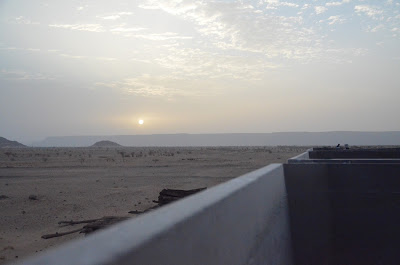 |
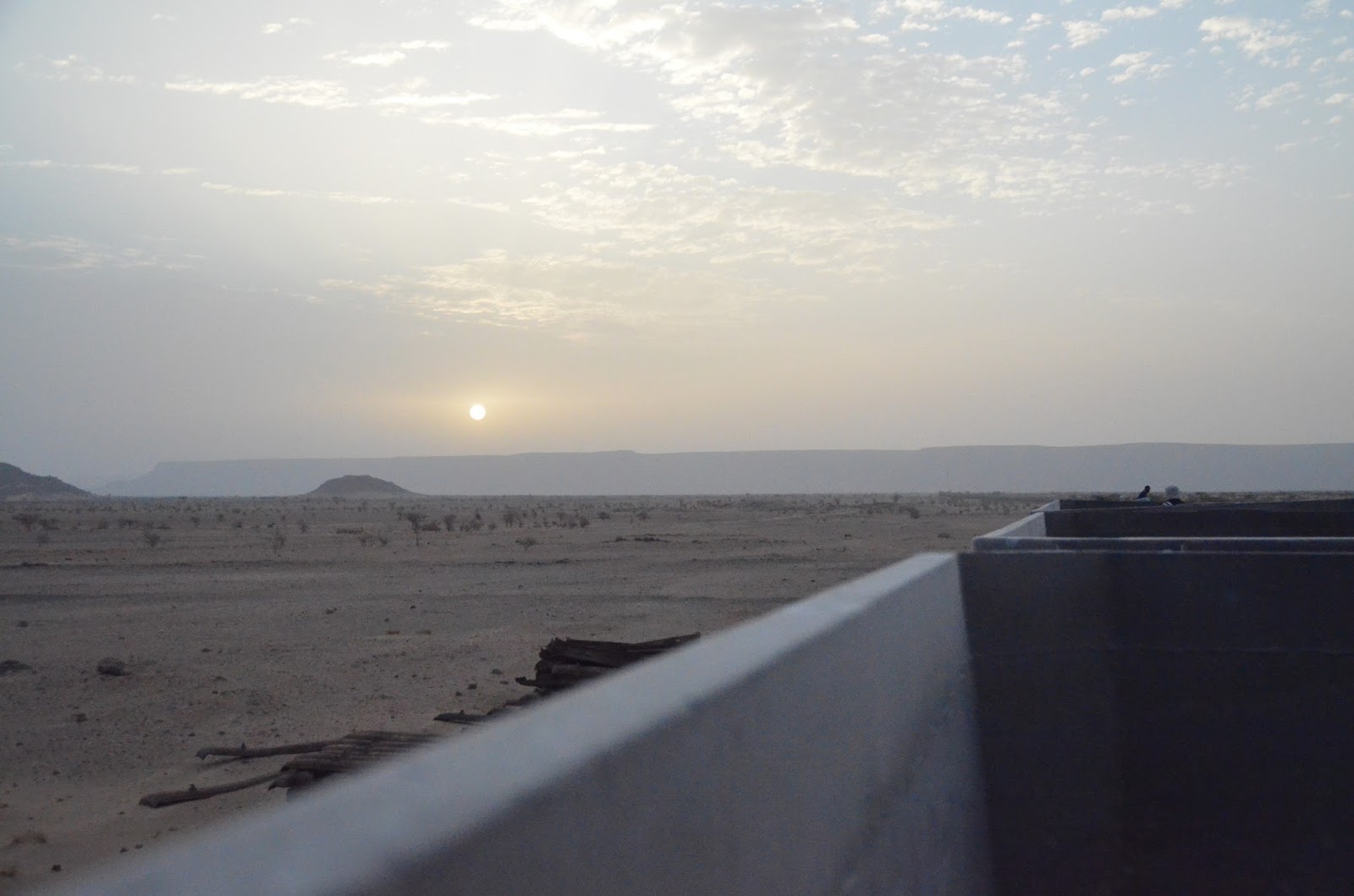
| The sun rises over Choum, just before the train pulled to a stop |
Just as the sun rose, we reached Choum, an hamlet notable only for being the closest the railway passes to the town of Atar. This was my stop. I heard the approaching roar of couplings slamming one more time, waited for the violent slam, and climbed out of the steel bathtub.
 |
| Passengers stretch before disembarking |
Several vans were waiting along the tracks to take passengers to Atar, and my Spanish-speaking travel companion helped me to find a place in one. After the sensory overload of the train journey, the half hour car ride to Atar seemed uneventful.
Upon arrival in Atar, a helpful local found me a pickup truck going to the desert caravan city of Chinguetti. Typically there are only one or two such trucks a day. The cab was already full, so I was offered a place atop the truck’s cargo. Fortunately for me, there was a foam sleeping pad atop the cargo that provided a comfortable perch as we sped along the gravel road. If there are no police for miles, are you really speeding?
 |
| A camel blocks our path. |
Once a significant center of Islamic learning and a hub for the trans-Saharan trade, Chinguetti has faded from its position of prominence. The heart of the old town has been almost entirely abandoned to the encroaching sands, with the exception of the mosque, built in the thirteenth or fourteenth century.
 |
| The entrance to the Chinguetti Mosque |
There are several privately-owned libraries in the city that hold hundreds of decaying manuscripts. Their owners resist their removal to a safer location. Because I visited in the sweltering heat of summer, most of these were closed. In fact, it was even difficult to find an open guesthouse, but I finally found a helpful owner who sweep the layer of sand off the floor. I enjoyed nightly Mauritanian tea – three cups of varying bitterness symbolic of life’s stages.
 |
| A Chinguetti neighborhood with the Saharan sand dunes behind |
As the sole foreigner in the village, I was the subject of constant attention, including the children’s constant requests for cadeaux – “gifts”. I never came across a child who didn’t ask me for cadeaux.
 |
| Chinguetti’s sole water tower, located on a small rise that marks the town’s highest point |
 |
| The ruined buildings of Chinguetti’s old town, with the mosque and its minaret at the center |
 |
| Sand swallows a building in the old town |
As the sun sank low in the sky on my last evening in Chinguetti, I set off on foot into the desert to explore the dunes for a few hours.
 |
| Exploring the dunes in the evening |
As I crested a dune, I found three camels left there by a nomad who had gone into town. They proved quite photogenic at sunset.
 |
| Chinguetti is surrounded by an endless sea of sand |
After my stay in the heat of Chinguetti, I was anxious to return to the cooler coast. A full day’s travel brought me to Nouakchott, Mauritania’s capital. I found my hotel comfortable the the city generally unremarkable, except for its colorful fishing port, which I spent an afternoon exploring.
 |
| The decorated prows of fishing boats on the beach. This one is decorated with a crescent and star, symbols of Mauritania. |
 |
| Fishermen pull their boat from the waves |
 |
| While some boats are dragged onto the sand each evening, others remain anchored offshore. |
Fishmongers clean and scale the catch for their customers, who have come to the market for the freshest of fish.
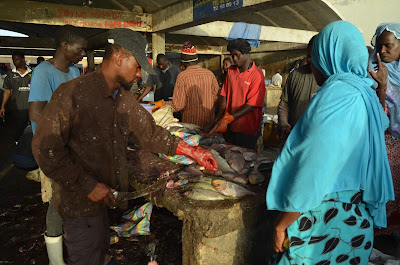 |
| A fishmonger scales a fish |
 |
| Fish lined up for sale |
After several relaxing days in the cooler climate of the capital, I went on to my next destination: Senegal. Several hours on a bus through increasingly green countryside brought me to Rosso, a river town. There is no bridge here, only small canoes to take you across the river. After an interminable wait for the immigration officer to finish his lunch, I was aboard one of these small boats and on Senegalese shores.
 0
0
 0
0





Wow, that train seems so cool! We definitely need to travel together again sometime.