 0
0
 0
0
Two weeks ago, I traveled through the Baltic States – Estonia, Latvia, and Lithuania. Here’s some overdue photos.
The Baltic States seemed like a convenient destination to squeeze into the week before my parents and younger sister arrived in Poland. Three countries in seven days was a far too ambitious plan, even for me. I think I still managed to see the highlights.
My trip was made easier by freak winter weather – the temperature barely dropped below freezing and there was no snow. The locals all expressed their befuddlement at this incredibly mild weather for the middle of December.
In what has become a theme in my travels, my journey began like an episode of The Amazing Race. My bus to the train station was cancelled one stop after I got on, so I was frantically searching the back streets of London for a cab at 4am. I found one just in time and barely made my train at Victoria Station. An hour later, I was at Gatwick Airport, uncertain of what to expect from my first experience with budget airline EasyJet. I should have expected the worst.
I assumed arriving at the airport two hours before my flight would be sufficient. The 85L backpack I carry doesn’t fit in the overhead compartments of most airlines, so I always check it. I paid for my bag in advance online (it’s cheaper that way) and was informed I’d merely have to drop my bag at the desk when I arrived at the airport. I was not informed that there would be over 500 people waiting in this line, or that it would take 90 minutes to get to the front.
Gatwick Airport has remote stands – the planes park away from the terminal and passengers are bussed out to the aircraft. Because the stand was so far away, the gate for my flight closed 30 minutes before departure (it’s normally ten in my experience). In total, this meant that after my bag was dropped off, I had four and a half minutes to clear security and get to my gate. A miraculously straightforward trip through security and a 1km dash through the terminal (it seems to go on forever) got me there on time.
I wasn’t the only one struggling to make the plane. As I was boarding the (supposedly) last bus to the plane, I overheard one employee say to another “That’s it. Close the flight.” The second employee responded, “But we still have people coming. And what about their bags?” Probably because so many were in a similar situation to me, EasyJet repeatedly pushed back our takeoff time and delayed closing the gate. We departed London more than half an hour late, and arrived in Tallinn, Estonia by about the same margin.
 |
| Waiting for the bus under a dramatic sky |
Just after checking into my hostel, I joined a tour of an old Soviet prison. It was originally constructed as a fortress overlooking Tallinn harbor, but several decades later was converted into a criminal prison by the then-independent Estonian government. It was designed to hold 1,200 inmates.
When the Soviets invaded Estonia in June of 1940, they quickly set up a puppet government that made the country a constituent republic of the USSR. With the new regime in place, the building was quickly converted into a political prison. The Soviets packed the prison with 4,800 inmates – four times capacity. At the same time, they began a program of mass deportations to labor camps (gulags) and forced resettlement farms. Deportations were essentially at random. Our tour guide’s grandfather was deported because he spoke six languages. Generally, those deported to the gulags never came back. Only about 70% of inmates survived their sentences, and those that did were frequently given new sentences on trumped-up charges.
In 1941, Hitler broke the oath he made to Stalin the year before and invaded Russia, eventually capturing the Baltic States later in the year. The Germans were welcomed as liberators – the general public couldn’t imagine anything worse than the Soviets. German rule, which lasted until 1944, was generally much better than life under the Soviets – unless you were Jewish. Most of Estonia’s Jews managed to flee the country, but those in Latvia and Lithuania were less fortunate. Latvia’s 70,000 Jews were wiped out. Of the 210,000 Jews that lived in Lithuania before the war, less than 3,000 returned home. In 1944, the Soviets “liberated” the Baltic States and the prison was shortly converted into a criminal pre-trial prison.
As I later traveled through Latvia and Lithuania, I found that the stories of all three Baltic States were similar. Their treatment of the three countries marched in lock-step during both the Soviet and German occupations.
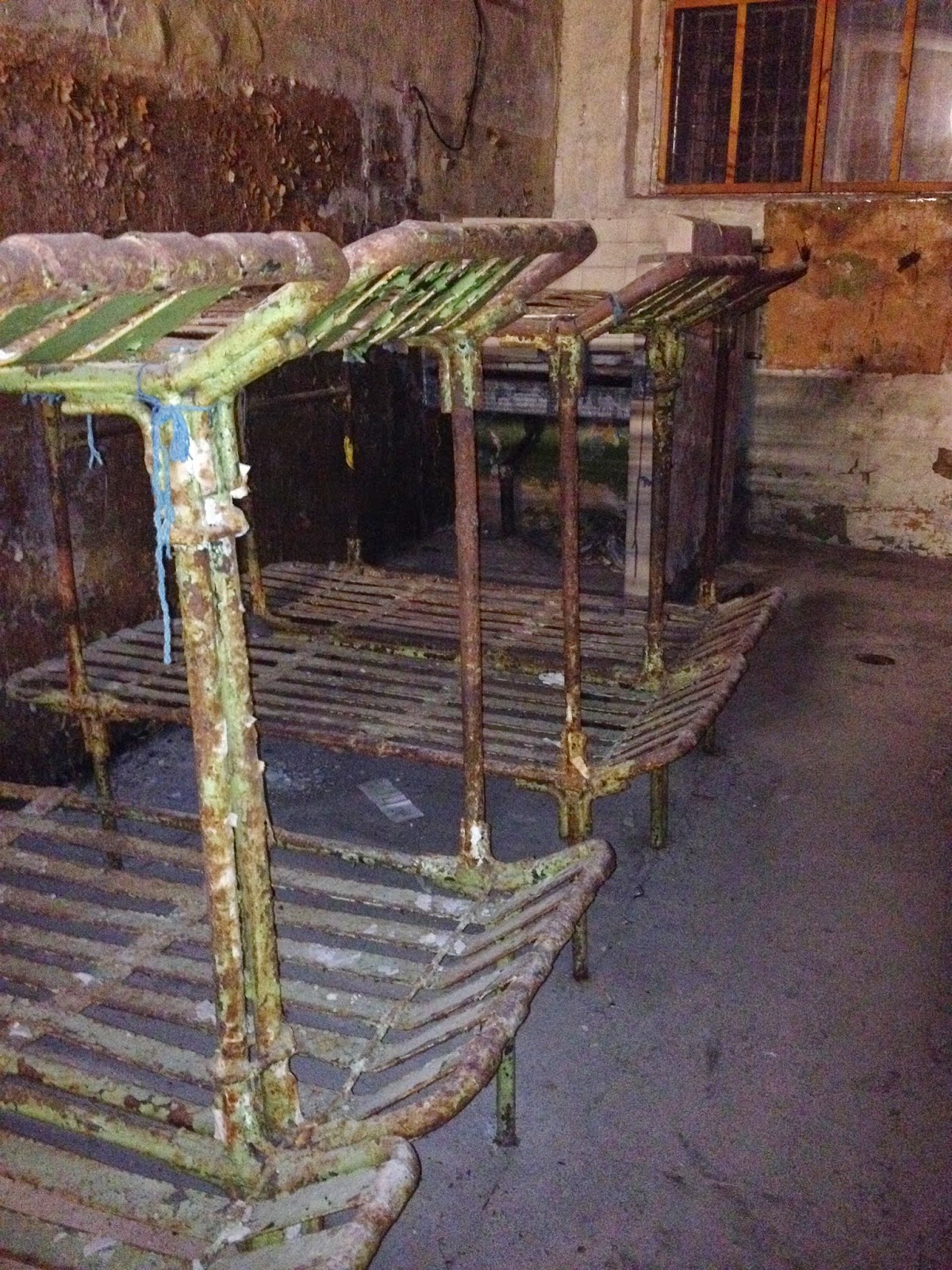 |
| The bare bunk beds in one wing of the prison. There were generally 3-4 inmates per bed, forcing them to sleep in shifts. |
 |
| Original prison art done by an inmate during the Soviet era. |
That evening, I went to eat at Drakkon (“Dragon”), a tiny little pub on the town square. It was almost dark inside, lit only by a few candles dispersed around the room. The atmosphere was extremely medieval, which was aided by the employees in period costumes. There were no eating utensils in sight – you ate the pies with your hands and slurped the soup from bowls. In all, it was a charming place for dinner and a pint of cider.

 |
| A panoramic view of Tallinn |
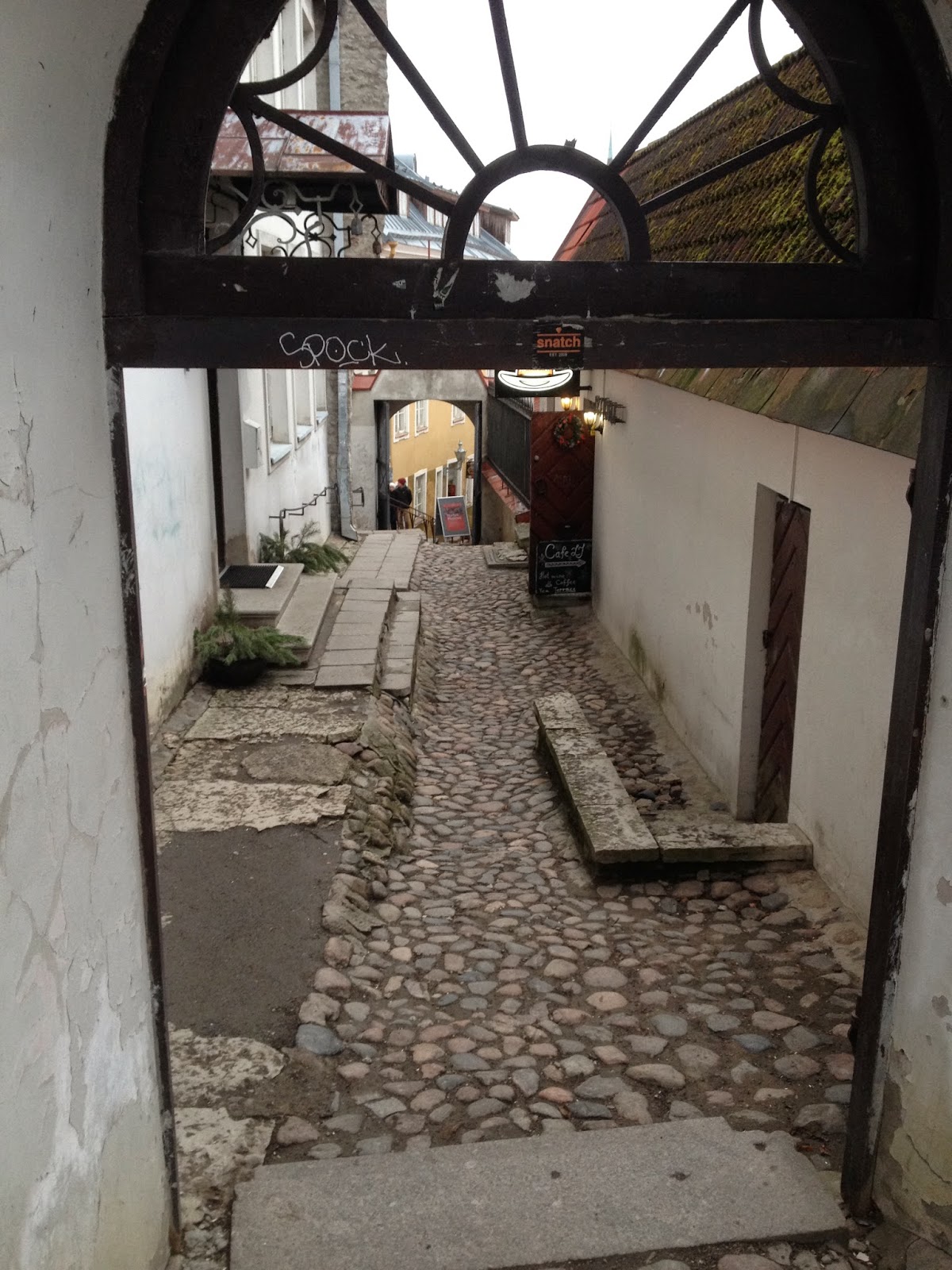 |
| A charming side-street |
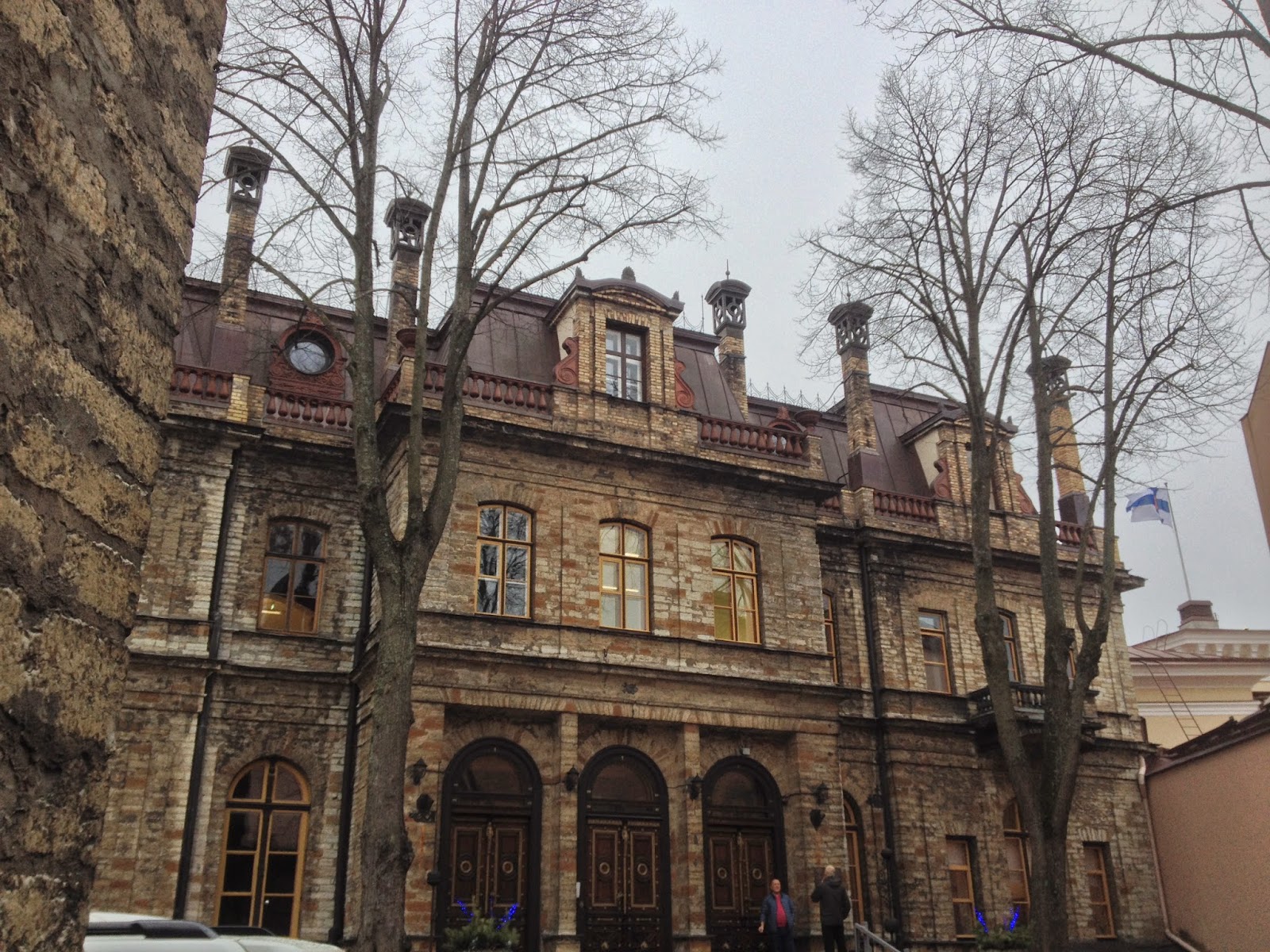 |
| The former palace of a powerful noble family – now the Estonian Academy of Sciences |
Alas, my stay in Estonia was far too short. I left this charming city for Riga, Latvia early the next morning. I initially planned to take the train to Riga, but the bus was cheaper, faster, and had free wifi. At the center of Riga is a large park which includes the Freedom Monument – dedicated to those who lost their lives in the first war of independence – fought between 1918 and 1920. I took photos from a few angles of the monument and surrounding park.
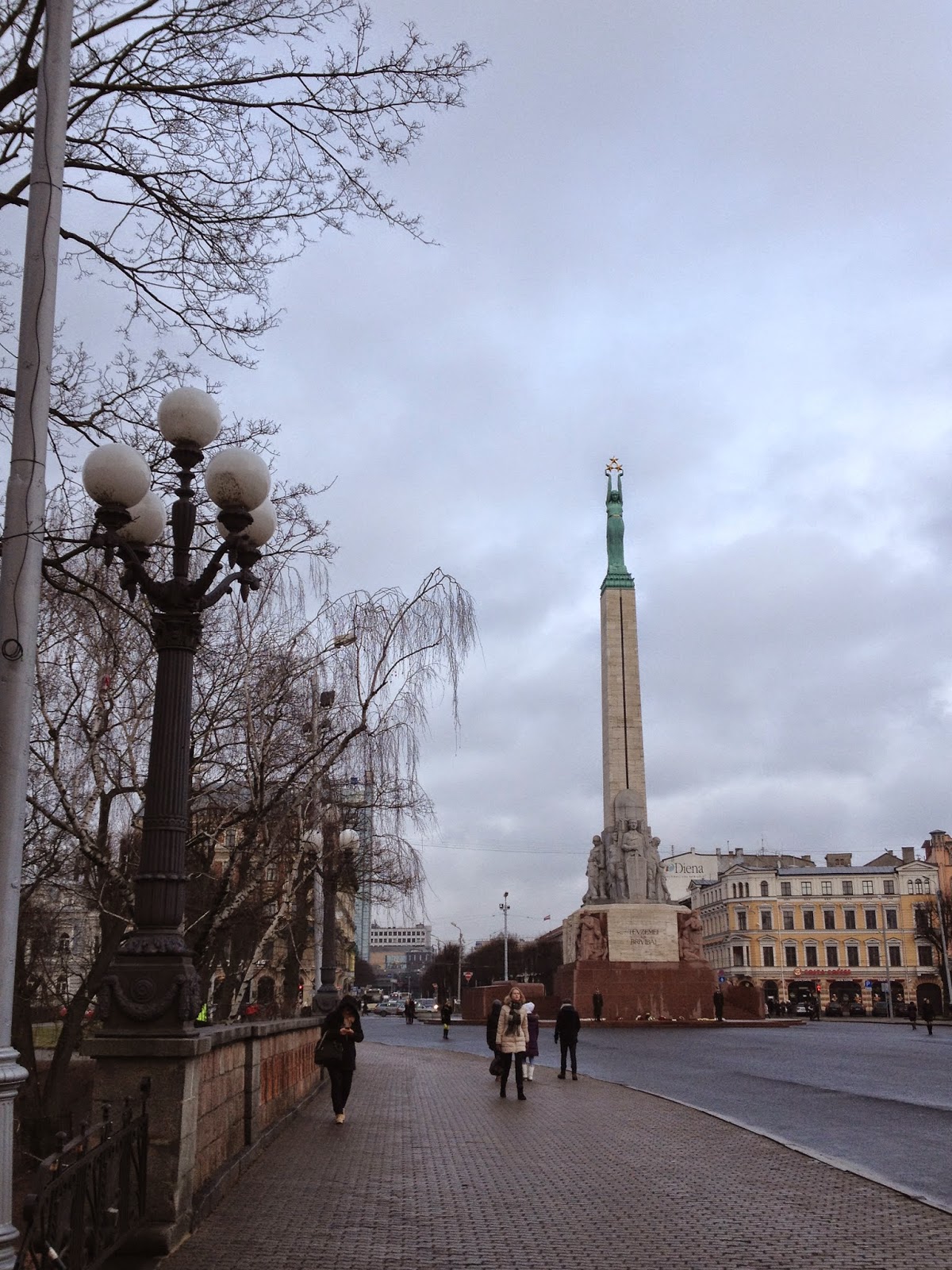


I didn’t take many other photos in Riga – mainly because I wasn’t feeling well and didn’t do too much. I did visit the Museum of Occupations – housed in the former US Embassy, which told the sad story of Latvia’s domination by the Soviets and the Germans from 1940 until 1990s. The story in Latvia sadly paralleled what I had heard in Estonia.
 |
| A pretty little side street I found on my way to lunch |
After a long bus ride that began early in the morning, I was greeted in Vilnius by the discovery that my arrival bus station “Panorama – City Center” was nowhere near either the Panorama Hotel or the City Center. Thus, I began a 40 minute hike with my pack to my hostel. Welcome to Lithuania.
My walk took me along the picturesque river that runs through the city.


By the time I arrived, there was time for little besides dinner and getting settled into my room. The next day, I went for a run late in the morning and explored the city after lunch.

In the late afternoon, I went to visit Lithuania’s Museum of Occupations, which is housed in the former NKVD (Soviet secret police) headquarters. The same building also served as the headquarters for the Gestapo during the German occupation. The rooms upstairs detailed a now-familiar story of the horrors of occupation, and the basement showed the largely undisturbed prison from the NKVD’s (and later, the KGB’s) tenancy.


After the walking tour, my newly reunited friends and I went to dinner. My plans for making it to the bus stop were repeatedly derailed, and my quest ended with a sprint through the streets to find a taxi and barely making the bus – with 30 seconds to spare. Another Amazing Race moment. On to Warsaw – where I would meet my parents and sister the next morning.




Howdy Cole! Enjoying your blog!